Migration process: From QlikSense to AWS Quick
By Gökhan Yüksel and Matthias Nist, 12 June 2026
The Client
A leading top-tier German automotive manufacturer initiated a strategic transformation of their reporting and analytics ecosystem as part of a larger cloud data platform modernization program. The objective was to move away from fragmented legacy BI structures and establish a scalable, cloud-native reporting environment capable of supporting enterprise-wide analytics, governance, and future data growth.
The project involves a dedicated team of 8 Full-Time Equivalent (FTE) staff and has been ongoing engagement since Q2 2025.
The Problem
The existing Qlik Sense reporting landscape had evolved over time into a highly customized environment with increasing operational complexity. Multiple business domains relied on different reporting structures, resulting in inconsistent data visibility, limited scalability, and growing maintenance effort. At the same time, the organization wanted to standardize reporting processes and improve performance without disrupting established business workflows.
One of the main challenges was that AWS Quick (formerly called QuickSight) and Qlik Sense follow fundamentally different architectural and functional approaches. Several business-critical dashboard behaviors and reporting features used by end users in Qlik Sense did not exist out of the box in Quick and therefore had to be redesigned or technically recreated. In parallel, the migration required harmonizing data from different sources through Snowflake and the central Cloud Data Hub while maintaining data quality, security, and reporting consistency.
The Solution
AKKODIS designed and implemented a modern analytics architecture based on AWS Quick, Snowflake, and AWS cloud services. The engagement covered the end-to-end migration of reporting assets, including data integration by accessing “raw” tables from Snowflakes and process the data in Snowflake, dashboard redesign, and optimization of the reporting data model for cloud-based analytics workloads.
A new semantic and reporting layer was developed to improve maintainability, performance, and scalability across business units. Existing Qlik Sense dashboards were analyzed in detail and re-engineered within Quick while preserving key business logic and user experience wherever possible. To close functional gaps between the two platforms, additional application-specific web extensions and collaboration capabilities were introduced, including custom commenting capabilities directly within reporting workflows with a frontend stack involving Angular and TypeScript.
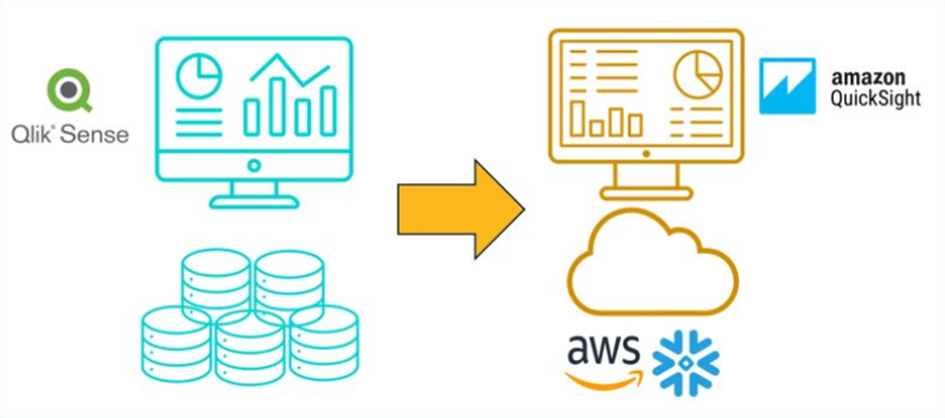
The solution also incorporated automated deployment and infrastructure management practices using Infrastructure-as-Code technologies such as Terraform, enabling more efficient environment provisioning and long-term operational stability.
The Outcome
The transition to the new platform has successfully streamlined the client’s reporting operations. By moving to a cloud-native architecture, we eliminated the fragmentation of the old system, resulting in a central, reliable single source of truth that is much easier for the project technical team to maintain with unified data source, lesser communication hops and more secure infrastructure than before. Data consistency has improved, and the optimized models mean that reports now load and update significantly faster.
Business users gained access to a more intuitive and unified analytics environment with faster dashboard response times and simplified access to enterprise reporting. The introduction of collaborative reporting functions also improved communication between departments and increased overall user acceptance of the new platform.
Looking ahead, the project has given the automotive client a truly flexible foundation. They are no longer held back by legacy constraints, meaning they can now roll out new analytics features or scale their reporting to meet new business demands with much less effort and lower costs.